Third-Party API Integration Services
Modern businesses rely on multiple digital platforms, applications, and cloud services to operate efficiently in today's competitive environment. Third-party API integration enables these systems to communicate securely and seamlessly, allowing businesses to automate workflows, synchronize data in real time, eliminate repetitive manual processes, and improve overall operational efficiency.
Whether integrating payment gateways, customer relationship management (CRM) systems, enterprise resource planning (ERP) software, social media platforms, cloud storage, mapping services, communication tools, AI-powered solutions, or other business applications, API integration helps create a unified digital ecosystem. By connecting critical business systems, organizations can enhance productivity, improve data accuracy, deliver better customer experiences, reduce operational costs, and make faster, data-driven decisions that support long-term business growth.
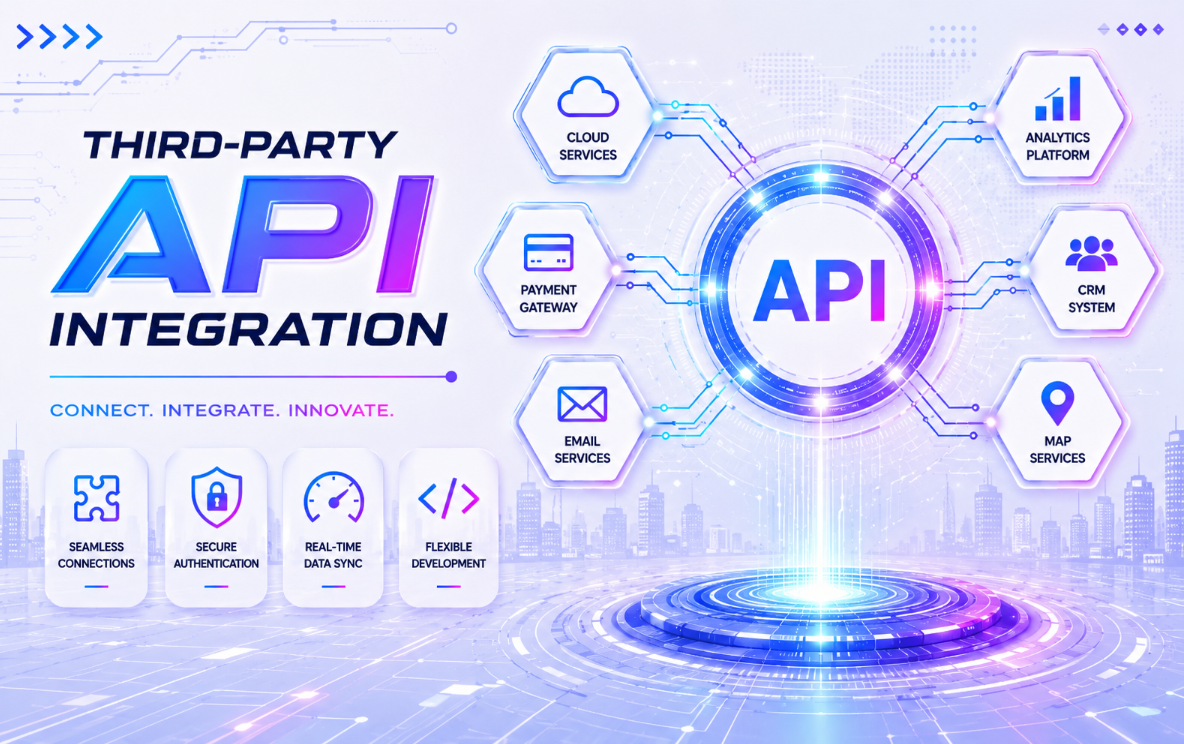
Professional Third-Party API Integration Solutions
A.I Digital Profile provides professional REST API development services and third-party API integration solutions that connect websites, custom software applications , databases, cloud platforms, and external business services.
Our API integration solutions help organizations reduce manual tasks, improve system communication, and build scalable digital ecosystems through secure and reliable integrations.
API Integration Services We Provide
- REST API Integration and Custom API Connectivity
- External Platform and Third-Party Service Integration
- Payment Gateway API Integration
- Cloud Platform API Integration with Modern Infrastructure
- Business Application and Software System Integration
- Database Integration and Real-Time Data Synchronization
- Secure API Authentication and Access Control
- Automated Data Exchange and Workflow Automation
- Custom API Solutions Based on Business Requirements
- API Monitoring, Maintenance, and Performance Optimization
Technical Approach to Third-Party API Integration
Reliable API integration requires careful consideration of how systems communicate, authenticate requests, exchange data, handle failures, and maintain synchronization. A.I Digital Profile evaluates these technical requirements before implementing an integration so that the resulting solution is designed around the capabilities and limitations of the systems being connected.
API Architecture and Communication
Depending on the platform and available documentation, integrations may use REST APIs, SOAP services, GraphQL APIs, webhooks, or other supported integration mechanisms. The integration architecture is selected based on the systems involved, required data flow, authentication model, performance requirements, and the capabilities exposed by the external service.
- REST API communication using HTTP methods such as GET, POST, PUT, PATCH, and DELETE
- JSON and XML request and response handling
- API endpoint configuration and request parameter handling
- Webhook-based event notifications and automated workflows
- GraphQL queries and mutations where supported by the platform
- SOAP-based integrations for systems that expose SOAP web services
Authentication and API Security
API integrations often require authenticated communication between applications. The appropriate authentication method depends on the external platform and its security requirements.
- API key authentication
- Bearer token authentication
- OAuth and OAuth-based authorization flows
- Access tokens and refresh tokens
- Secure credential and secret management
- HTTPS-encrypted API communication
- Authorization and access-control considerations
API credentials and sensitive authentication information should be protected and should not be exposed in client-side source code, public repositories, URLs, screenshots, or publicly accessible configuration files. Integration implementations should follow the security guidance and requirements provided by the API provider.
Data Mapping and Transformation
Different systems frequently represent the same information using different field names, formats, identifiers, and data structures. Integration therefore requires careful mapping and transformation of data between the connected platforms.
- Mapping fields between source and destination systems
- Transforming JSON, XML, and other supported data formats
- Normalizing dates, identifiers, currencies, and other values
- Validating required fields before data transmission
- Handling optional, missing, or unexpected data
- Maintaining consistent identifiers between connected systems
Error Handling and API Reliability
External APIs can return errors for many reasons, including invalid credentials, malformed requests, unavailable services, authorization failures, rate limits, network problems, and temporary service outages. A reliable integration should account for these conditions rather than assuming every request will succeed.
- HTTP status code handling such as 2xx, 4xx, and 5xx responses
- Validation of API responses before processing returned data
- Timeout and connection failure handling
- Appropriate retry strategies for temporary failures
- Rate-limit and throttling considerations
- Logging of relevant integration events and failures
- Graceful handling of unavailable external services
Webhooks and Real-Time Data Exchange
When supported by the external platform, webhooks can allow an external service to notify an application when an event occurs. This can reduce the need for continuous polling and can support more responsive workflows.
Webhook implementations may require endpoint validation, request verification, event processing, duplicate-event protection, response handling, and appropriate logging. The exact implementation depends on the webhook capabilities and security requirements of the service provider.
API Rate Limits and Performance
Many third-party APIs impose request limits to protect their infrastructure. Integrations that make frequent requests should consider the provider's documented limits and usage policies.
- Monitoring API request frequency
- Reducing unnecessary API calls
- Using webhooks where appropriate
- Handling rate-limit responses
- Applying controlled retry and backoff strategies when appropriate
- Considering caching where the API and business requirements permit it
- Designing synchronization processes around provider limitations
API Testing and Validation
Before an integration is placed into production, API requests and responses should be validated against the provider's documentation and the project's requirements. Testing helps identify authentication, validation, data-mapping, error-handling, and workflow problems before they affect production processes.
- Authentication and authorization testing
- Request and response validation
- Required-field and input validation
- Successful and failed request testing
- Webhook event testing where applicable
- Rate-limit and timeout behavior testing
- Data synchronization verification
API Monitoring and Maintenance
Third-party APIs can change over time. Providers may introduce new versions, modify endpoints, change authentication requirements, update response structures, or discontinue older functionality. For this reason, API integration should be treated as an ongoing technical component rather than a one-time connection.
Where maintenance is included within the agreed project scope, API integrations can be reviewed for compatibility, errors, performance, authentication changes, and other issues that may arise as connected platforms evolve.
API Integration for Digital Transformation
API integration plays an important role in digital transformation by allowing businesses to connect their existing tools with modern technologies. Whether you need payment integration, cloud connectivity, data synchronization, or business automation, A.I Digital Profile creates secure solutions designed for long-term scalability.
Our API solutions can also be combined with cloud deployment services, database solutions, cybersecurity services, and AI automation solutions to create complete digital platforms for modern businesses.
Related Technology Services
Our API Integration Project Process
Every project and service request is unique. After receiving your requirements, A.I Digital Profile will review your request and prepare a personalized quotation outlining the proposed scope of work, estimated timeline, pricing, and payment terms.
- Contact us with your project or service requirements.
- We review your request and discuss your goals if additional information is required.
- You receive a personalized quotation by email.
- Once you approve the quotation, payment instructions will be provided.
- Work begins after payment has been confirmed and all required information, files, or materials have been received.
For services with published package prices, the listed price applies to the standard scope of work. Additional features, revisions beyond the included limit, or custom requirements may require a separate quotation.
Frequently Asked Questions
What is third-party API integration?
Third-party API integration connects your software, website, or business application with external platforms, allowing secure communication, automation, and real-time data exchange.
Which APIs can be integrated?
Businesses can integrate payment gateways, CRM platforms, ERP systems, cloud services, accounting software, shipping providers, communication platforms, AI services, and many other third-party APIs.
Why is API integration important?
API integration improves productivity by automating workflows, reducing manual data entry, synchronizing information across systems, and enabling secure communication between applications.
Can existing business systems be connected using APIs?
Yes. Existing websites, legacy systems, cloud applications, databases, and enterprise software can be connected using secure API integration solutions tailored to business requirements.
Connect Your Business With Powerful Third-Party APIs
Ready to extend the capabilities of your applications? A.I Digital Profile delivers secure, scalable, and reliable third-party API integration services that seamlessly connect your software with payment gateways, CRM platforms, cloud services, social media, mapping solutions, communication tools, AI platforms, and other business applications. We build efficient integrations that automate workflows, improve data accuracy, reduce manual tasks, and help your business operate more efficiently.
Request Third-Party API Integration Consultation